Shopping Assistant Showdown: SensiBuy vs. Dupe, Coupert, Capital One, & PayPal Honey
The browser extension marketplace is crowded with promises of easy savings. But not all shopping assistants are created equal. We pit SensiBuy against four major players to see which tool truly serves the consumer.
If you've shopped online recently, you've likely been bombarded with advertisements for browser extensions promising to slash your bills. From coupon code searchers to visual clone finders, they cover every niche.
However, many of these "free" tools come with hidden catches: bloated user interfaces, sponsored redirections, deceptive messaging, or coupon aggregators that simply fail to deliver. Today, we're laying out the pros and cons of SensiBuy and four of the most popular alternatives: Dupe, Coupert, Capital One Shopping, and PayPal Honey.
1. Dupe: The Bloatware of Tomorrow
Pros: Dupe has gained popularity for its ability to find "dupes" (duplicates or highly similar items). The product has well-funded marketing campaigns, and quite frankly, looks nice on the surface. It also doesn't require a sign-up or login, which is a huge benefit for users who aren't looking to become the product. But unfortunately, that's all it really has.
Cons: Honestly, Dupe just sucks to use. Not only does their LLM-centric method rarely find actual visual matches or deals on the item you're trying to purchase, but it feels cumbersome after the first five seconds. Instead of using modern iframe techniques to display their User Interface (UI) over the page, they use the actual Chromium sidebar API like heathens, shifting your page layout in a jarring fashion. They also decided to insert an LLM agent for seemingly no reason… Nobody wants to "Chat to refine" the results of their search. Even if you did somehow find a result you thought was worth checking out, you have to wait to be redirected to the listing through their site instead of just being able to follow a link directly where you want to go. The final nail in the coffin? Beyond having poor results and a terrible UI, they show ads at the top of your search results! The product clearly isn't focused on saving the user money if paid advertisement is included.
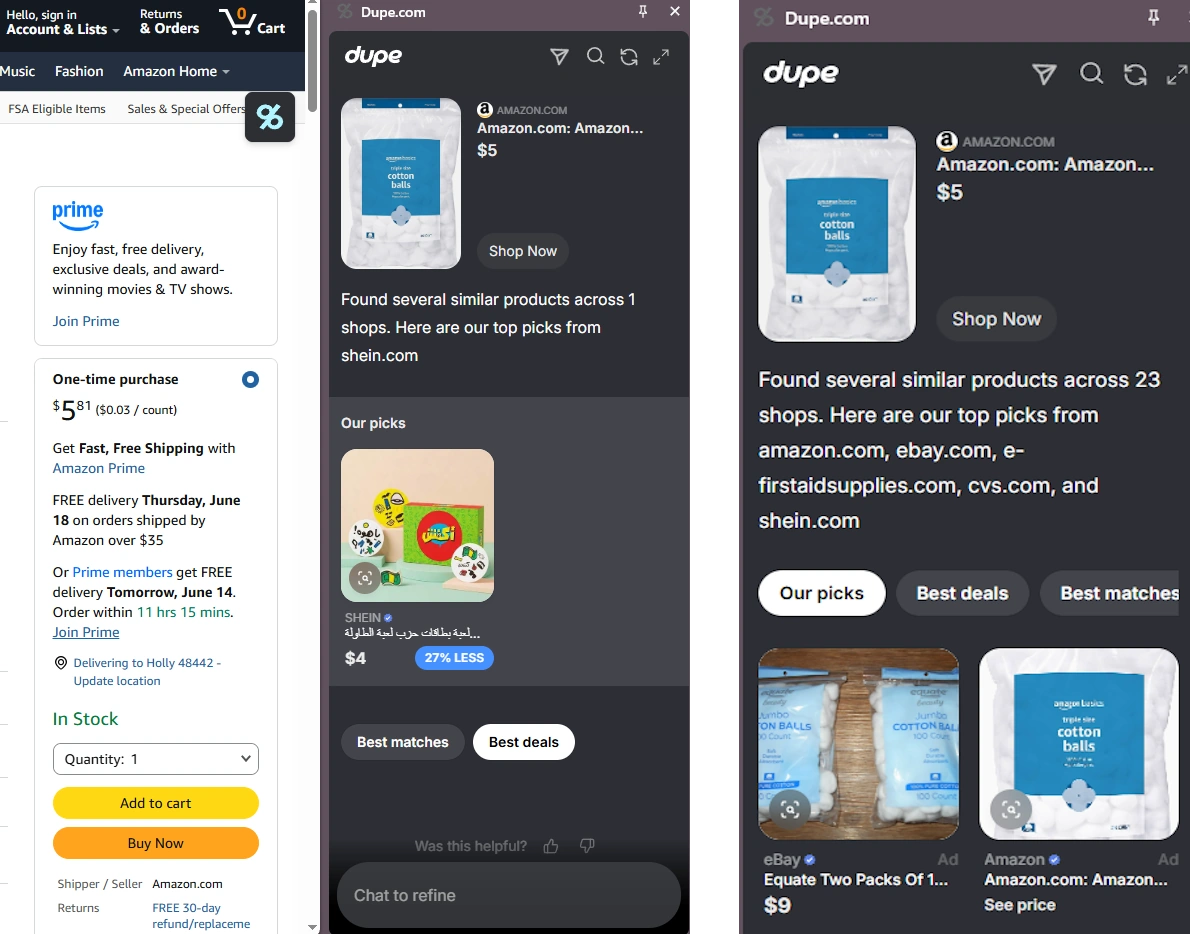
Summary: Dupe is the AI slop you've likely been warned about. You would be better served manually searching Google Shopping than wasting your time wading through this swamp of a platform.
2. Coupert: Saving Money at What Cost
Pros: Coupert is a well-known extension that goes beyond finding deals and coupons, and actually offers cashback rewards for remaining in their ecosystem. It's more of a shopping platform than a shopping assistant tool, but Coupert will definitely manage to save you money when shopping online, which is more than can be said for some of the other options (hello, Dupe). It may seem intrusive at first, but Coupert does at least have a robust “Preferences” panel to tone down the notifications.
Cons: If you use Coupert, please understand that you are the product. Their goal is to entice you to participate in their broader ecosystem; not only do they want your affiliate credit, they want you to view ads, take surveys, and complete tasks that they can monetize directly and pay you fractions of pennies for.
Summary: Honestly, Coupert is a good choice. If SensiBuy is incompatible with the browser you prefer or you prefer cashback rewards over the cheapest deals, I would highly recommend installing Coupert. If you are comfortable ignoring ads and spammy attention grabs, you will not be disappointed.
3. Capital One Shopping: Coupert But Ugly
Pros: Capital One Shopping is another example of a shopping platform masquerading as a shopping assistant extension. They offer deals, coupons, and cashback rewards for those who are willing to create an account and shop in their ecosystem. There certainly are real rewards presented, and they can even beat out Coupert in terms of cashback in some cases. They have more of a focus on travel, with specific sections for tickets and hotels, which can prove useful.
Cons: Capital One Shopping is just a worse version of Coupert. Not only does Capital One's product feature outdated styles and poor UI choices, sometimes, it just doesn't work at all!

The product databases seem eerily similar, so you probably won't miss out on many deals compared to using Coupert, but Capital One Shopping somehow has more ads than Coupert, even if the outdated formatting makes them less attention-grabby. Not only that, but Capital One Shopping's user preferences settings are seemingly nonexistent, so there is no way to turn off the popups when shopping for those who find them obnoxious. All of this, combined with the fact that every link inconveniently redirects through their site, means that Capital One Shopping managed to concoct a user experience so unappealing, they surpass only Dupe (quite the low bar).
Capital One Shopping also suffers from the same data-privacy risks as Coupert, since most functionality requires you to create an account.
Summary: Unless you are already a fan of the Capital One ecosystem or primarily shop online for travel, you would be better served using Coupert.
4. PayPal Honey: Scams Free of Charge
Pros: PayPal Honey is one of the most well-known shopping extensions as of today. Sometimes, the coupons they provide save you some money. If you connect a PayPal account, you can also benefit from some cashback rewards for shopping at select retailers.
Cons: PayPal Honey is for suckers. They've made that clear with their unscrupulous business practices in the past. Be it stealing partnered influencer's affiliate credit, hiding coupons from users, or saying you have the “best deal!” after not even checking (and then taking affiliate credit), PayPal Honey seemingly doesn't care about attracting bad press.
Summary: If you are still using PayPal Honey in 2026, your name might be Patrick Star. For those who have self-respect, any other option is better… except for Dupe.
5. SensiBuy: The New Best Choice
Pros: SensiBuy is a simple but effective tool; show it a product, and it will scan the internet for cheaper listings of an identical or similar alternative. There are no ads. You do not need to sign in or make an account. There are no obnoxious pop-up notifications. Every link goes directly to the product page. Results are intelligently sorted on a price-per-unit basis when available. You can deeply customize your search preferences to tailor your experience. SensiBuy even has bookmarks so you can save search results for later. All of these features are packed into a smooth, custom sidepanel UI, allowing users to stay on the page where they started until they decide to click a direct link to the cheaper listing SensiBuy found.
Many alternatives specialize in a niche product category or only support select retailers, but with SensiBuy, you can whitelist or blacklist any site you want, meaning it will work virtually anywhere and for any product. Platforms like Coupert limit you to 10 blocked domains, but with SensiBuy, there are no limits.
Cons: SensiBuy is in its infancy; it is not widely supported across many browsers, devices, and languages like all of the above products backed by tech giants. There is no mobile app yet, so usage is still quite limited. Testing has only been done on Chromium browsers in a desktop environment; when used outside of this scope, users may encounter bugs. The help team consists of only one person (myself, as the sole developer), so responses to issues may also be slower than expected.
The search method utilizes zero backend APIs, causing the search duration to be longer than most of the other options. Using incognito search windows does still require user trust (permissions to run in incognito mode), but the lack of accounts and backend APIs ensures that zero user data is collected or sold. Because the search occurs entirely natively in the user's browser, sometimes the incognito search windows briefly appear before they are minimized, which can cause confusion for first-time users.
Summary: If you're looking for a shopping assistant that will simply show you the best prices, SensiBuy is the correct choice. Zero ads, no logins, direct-to-product links, and intelligent price comparisons allow SensiBuy to stand out from the crowd. However, if you need cashback features, mobile support, or use non-Chromium-based browsers, you may need to look elsewhere.
The Verdict: Which Assistant is Right for You?
Your choice depends entirely on what you value most when shopping online:
- Choose SensiBuy if you are using Chromium-based browsers and do not need cashback incentives.
- Choose Coupert if you really want cashback rewards or SensiBuy isn't supported on your browser/device.
If you're intent on finding the absolute best deal in any situation, you can even use a combination of different extensions, though I cannot honestly recommend Dupe, Capital One Shopping, or PayPal Honey.